• Welcome to H4O! For a reduced ad experience, please login or register with the forum.

Supplemental Oil Feed Line

Mikey13b

Member
Messages
11
Location
Australia
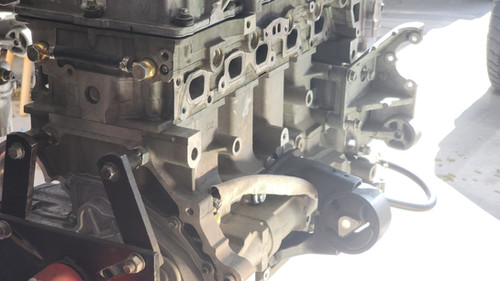
Hi guys, has anyone fitted a supplementary oil feed line to their engine, such as the below or similar?


Last edited:

650Hawk

Well-Known Member
Messages
546
Location
SoCal
I guess the theory is good, but I've not really heard that the bearings for cylinder #5 is a common failure point, and they've been out for decades.
 

Happy Hummer

Well-Known Member
Messages
1,462
Location
Wisconsin
jmho
I just did a cursory search and didn't find any stuff about bearing failure in 3.5 or 3.7l being all to common. I'm always open to learning stuff but this seems to be not so much important. Has any other H3 peeps come across this item being needed?
 

650Hawk

Well-Known Member
Messages
546
Location
SoCal
It seems to me that as long as the oil pump is putting out the sufficient pressure, cyl #5 gets just as much as cyl #1. Cyl #1 doesn't "take" pressure from the system, followed by cyl #2 taking some more, cyl #3 taking more, etc., leaving very little for cyl #5. That's not how a pressurized system works. This guy designed a solution(?) to a problem that doesn't exist, which makes his "knowledge" and abilities as a mechanic suspect.
 

rascole

Well-Known Member
Messages
2,830
Location
Bellflower, CA
It seems to me that as long as the oil pump is putting out the sufficient pressure, cyl #5 gets just as much as cyl #1. Cyl #1 doesn't "take" pressure from the system, followed by cyl #2 taking some more, cyl #3 taking more, etc., leaving very little for cyl #5. That's not how a pressurized system works. This guy designed a solution(?) to a problem that doesn't exist, which makes his "knowledge" and abilities as a mechanic suspect.
Not true, pressure and flow are not equal to every component in the engine. Oil pressure sensor is located in the front of the block, nearest to #1 cylinder, pressure and flow are reduced by the time it hits #5. Depending on the age and wear, pressure can be significantly lower at the end of the oil passage. I will agree that there does not seem to be a lot of evidence that #5 is a bad actor. I will give him credit for taking the time to dig into a possible problems and coming up with a fix, he has other solutions and does seem to know more than the average Joe.
 

650Hawk

Well-Known Member
Messages
546
Location
SoCal
Not true, pressure and flow are not equal to every component in the engine. Oil pressure sensor is located in the front of the block, nearest to #1 cylinder, pressure and flow are reduced by the time it hits #5. Depending on the age and wear, pressure can be significantly lower at the end of the oil passage. I will agree that there does not seem to be a lot of evidence that #5 is a bad actor. I will give him credit for taking the time to dig into a possible problems and coming up with a fix, he has other solutions and does seem to know more than the average Joe.
Perhaps, but if the system is working as designed, the pressure and flow to the rear cylinder should be sufficient. A garden hose with 5 sprinklers on it produces the same pressure/flow at all 5 sprinklers, unless there is insufficient pressure to begin with.
 

Jeepwalker

Well-Known Member
Messages
976
Location
WI
I've heard of it, but not done it. I'm looking at a potential rebuild coming up, so I've got some 'thinking' to do on it. On another foum (355) it's debated too, weather effective or not. Mine just rolled over 200k mi. And the oil pressure on my I-5 since I bought it has been abysmally low. Like 9-10psi at hot idle (foot on brake...in gear). But it goes up to 25 on the road. That's not good. But it's been like that for tens of thousands of miles. But I agree with the idea of the extra line ....probably not a bad belt & suspenders idea. So long as the line is well-supported.

Side note: We used to have a JD farm tractor when I grew up, which had a thin hydraulic steel line ..maybe 1/4" OD x ~13" long, which...I forget now what fluid went through it. For no reason that steel line would crack and spew a LOT of oil all over the place in a very short amt of time. Fortunately an attentive operator could see the leak and shut it down. The line never moved much and there was no physical stress on it. But you could feel a vibration in it. The way it cracked it seemed it was harmonics which causesd it to crack in the same location. This was more rigid than brake line. Finally we made our own rigid steel line and put a small loop in it and a tie-down. Never had a problem with it after that. Ever. The point is, a guy would definitely want to ensure the steel line had the ability to expand & contract tens of thousands of times and did not suffer any harmonics or other effects which could potentially kill the patient, so to speak.

Thanks for sharing.
 
Last edited:
Top